Key takeaway
A 15 by 15 board has 225 playable points. Use coordinates to record exact positions and count whole five-point segments rather than guessing from nearby stones.
In this article
- Intersections are the playable positions
- Learn the coordinate system from the center
- Trace the horizontal and vertical lines
- Trace both diagonal slopes
- Use five-point windows to count threats
- Board edges remove continuation points
- What changes on a larger casual board
- A compact board-reading exercise
- Record positions that you can rebuild
A Gomoku board is simple enough to draw on paper, but reading it accurately takes practice. You need to know which points are playable, how to describe a move and how to trace all four winning-line directions. These details help you follow a strategy article, explain a puzzle and review a game without losing track of the actual position.
Gomoku.now uses a 15 by 15 board. The official International Rules of Gomoku also describe a board with 15 horizontal and 15 vertical lines, giving 225 intersections. Casual games can use other sizes by agreement, but an article or puzzle based on one playing area should not be assumed to behave identically on another.
Intersections are the playable positions
On a lined physical board, stones go where the horizontal and vertical lines cross. Fifteen lines in each direction produce fifteen rows of fifteen points. The spaces between the lines are not additional positions. This distinction matters when drawing your own board, because counting squares instead of intersections can give you the wrong playing area.
Some interfaces represent positions as clickable cells rather than visible intersection dots. That visual choice does not necessarily change the logical game. There is still one stone per position and one position for each row-and-column coordinate. Before placing a physical stone, make sure both players are using the same representation rather than mixing square centers and line crossings.
Learn the coordinate system from the center
In the site's diagram notation, columns are a through o and rows are 1 through 15. The center is h8. The point i8 is one column to the right in notation, while h9 changes the row. The point i9 changes both coordinates, creating a diagonal relationship. You can understand most examples by starting from h8 and counting outward.
Coordinates are labels, not a new rule. They help preserve a position exactly when you write it down. If you say three stones near the middle, a reader may rebuild a different shape. If you say f8, g8 and h8, the intended row is clear. Exact labels are especially valuable for broken lines, where the location of one missing point determines the threat.
Trace the horizontal and vertical lines
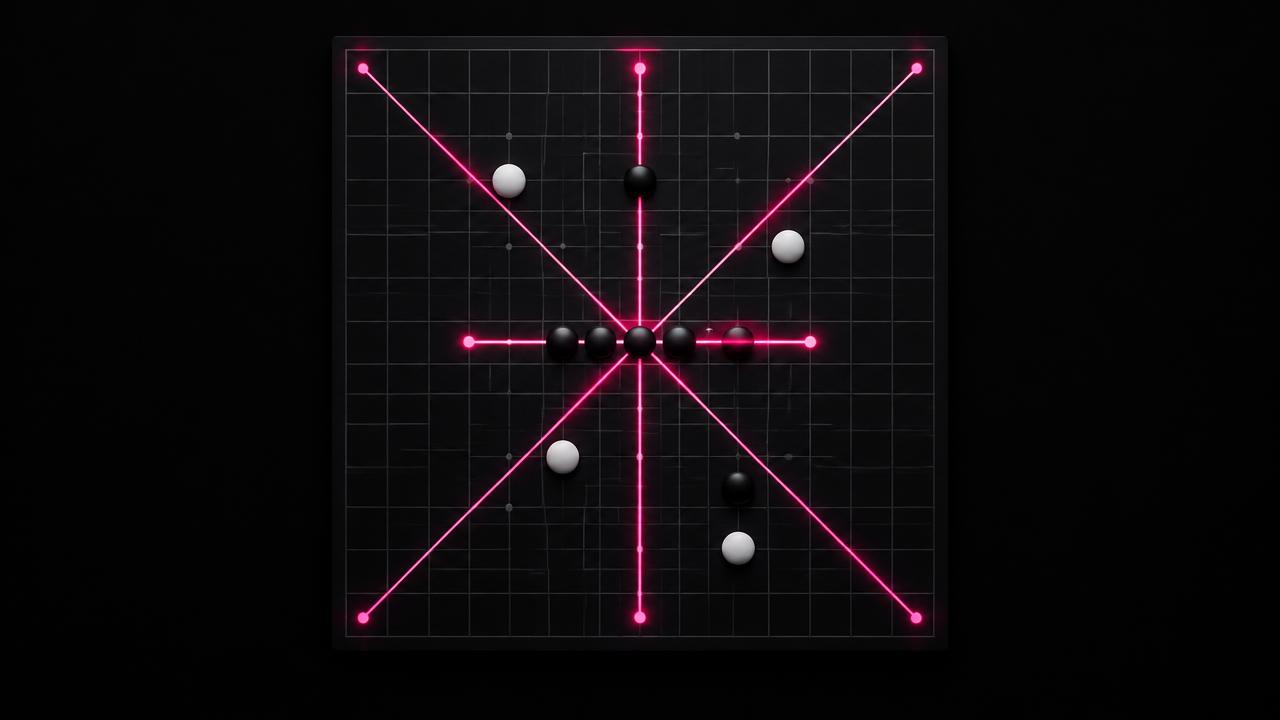
For a horizontal line, the row number stays the same while the column changes. Black at e8, f8, g8, h8 and i8 has five across row 8. For a vertical line, the column stays the same while the row changes. Black at h5, h6, h7, h8 and h9 has five along column h.
When counting a potential line, stop at an opposing stone or an empty gap unless you are explicitly examining a future completion. Five stones somewhere in the same row are not necessarily five in a row. The final winning segment must be uninterrupted and must meet the selected variant's rule about line length.
Trace both diagonal slopes
A diagonal changes the column and row together. The sequence e5, f6, g7, h8 and i9 is one slope. The sequence e11, f10, g9, h8 and i7 is the other. Every step moves one column and one row. Skipping a coordinate leaves a gap, even if the stones look broadly aligned from a distance.
The drawn grid can make diagonals harder to notice because it emphasizes horizontal and vertical lines. During a game, deliberately scan both diagonals through the last stone. During study, write the five coordinates in order. That small habit often reveals an overlooked winning gap or an endpoint that lies outside the board.
Use five-point windows to count threats
A five-point window is any consecutive segment of five valid positions along one line. For example, e8 through i8 is a horizontal window. If four of those points are Black and the remaining point is empty, that empty point may complete five. If one point is White, that particular window cannot become an uninterrupted Black five without changing rules to a different game.
This method catches broken fours. Black at e8, f8, h8 and i8 has a winning gap at g8 in the e8-through-i8 window. A scan that only counts consecutive runs might see two pairs and miss the immediate threat. Windows turn the board from a collection of visible clusters into a set of exact possible completions.
Board edges remove continuation points
A line near the boundary may not have room on both sides. Black at a8, b8 and c8 can extend to d8, but there is no point before a8. That four has only e8 as an immediate horizontal completion. Black at b8, c8 and d8 can extend to e8 with both a8 and f8 available, producing a different threat.
This is why moving a puzzle onto a smaller board can change its answer. If the new boundary removes an endpoint, an open four may become single-ended. If it removes a distant counter-threat, a previously unsafe attack may become safe. Preserve the playing area as well as the stones when transferring an example.
What changes on a larger casual board
A larger board offers more empty locations and may give some clusters additional continuation room. It does not mean that every distant move is useful. Most tactical decisions still involve existing stones, immediate threats and crossing points. Extra space can alter a specific position without turning random placement into a sound plan.
If you share a 19 by 19 Go set for a casual Gomoku game, agree whether the whole board is active or only a marked 15 by 15 section. A board used for Go does not bring Go capture rules into Gomoku. The equipment and the rules are separate decisions, and both should be clear before play begins.
A compact board-reading exercise
Write Black at f8, g8 and h8. List the points needed to create an open four by extending right: i8 is the new stone, while e8 and j8 must remain available as winning endpoints. Then rotate the exercise vertically using h6, h7 and h8. Name the corresponding extension and endpoints before making a move.
Finally use the diagonal f6, g7 and h8. Check i9, e5 and j10. Repeat with one endpoint blocked by White. You are learning to translate the same threat between orientations, not memorizing different rules for each direction. Coordinates make the comparison precise enough that you can explain exactly what changed.
Record positions that you can rebuild
When keeping study notes, write the rules, whose turn it is, board size and both colors' coordinates. If you record only your own stones, you may miss the opponent's winning threat that makes your planned attack fail. If you omit the turn, the same arrangement can have a different tactical answer.
For a short line exercise, a simple coordinate list is enough. For a game review, move order can also matter because it reveals when a threat became preventable or forced. The board is your shared reference. Reading it accurately lets you compare ideas, test examples and learn from games without accidentally analyzing a different position.
References
Frequently asked questions
How many points are on a Gomoku board?
A 15 by 15 board has 225 intersections. Other casual board sizes can be used by agreement, but they are different playing areas.
What is the center coordinate on Gomoku.now?
The center is h8. Columns run a through o and rows run 1 through 15 in the site's diagram notation.
Can I study Gomoku on a smaller grid?
Yes, for local tactical exercises if the full relevant lines fit. A smaller boundary can change open-four possibilities, so it is not equivalent to every full-board position.
Put it into practice
Try these ideas against the computer or a friend.
Editorial standards and sources
Rules depend on the variant being played. Worked examples are study positions, and computer suggestions are not proofs of perfect play. Consult the linked rule sources when checking a disputed position.
Topics
Share this article
Read about the editorial byline, source selection and how to report a correction. Cover artwork is illustrative, not a record of the example position.