Key takeaway
Place stones on intersections, check all four line directions after each move, and answer an immediate winning threat before building your own attack.
In this article
Gomoku is a two-player game in which Black and White take turns placing stones. Your aim is to make an uninterrupted line of five of your own stones before the other player does. A line can run horizontally, vertically or along either diagonal. You do not move or capture stones. Each turn adds one stone to an empty point, so every placement changes what can happen later.
This guide walks through a small practice game rather than asking you to memorize a list of rules. The example uses freestyle Gomoku, where five or more consecutive stones wins. Competitive variants can handle longer lines differently. Check the selected rules before starting, especially if you have learned the game somewhere else.
Read the board before making a move
A 15 by 15 board has 225 intersections. Coordinates help you talk about them: columns run from a through o, while rows run from 1 through 15. The center is h8. The coordinate h9 is directly next to h8 in the same column. The coordinate i9 sits one column and one row away, making a diagonal connection.
You do not need to remember every label immediately. Start by finding the center, the four line directions through it and the board edges. A row of stones touching an edge has less room to grow than the same row in the middle. That is why opening near the center makes learning easier: there are fewer accidental restrictions on your practice shapes.
Place the first few stones
For an introductory example, let Black play h8 and White play h9. Black then adds i8. Black now has two stones next to each other across row 8. White could challenge this pair by playing j8, or build a different connection nearby. Neither side has an immediate winning threat yet, so both can make a planning move.
When you play these moves yourself, notice that White's h9 is not part of Black's row. Stones of different colors cannot combine into a winning line. Black's h8 and i8 must eventually connect to three more Black stones without a White stone or empty gap interrupting the final five. A nearby White stone matters only if it blocks an important extension or creates White's own attack.
Build a practice threat
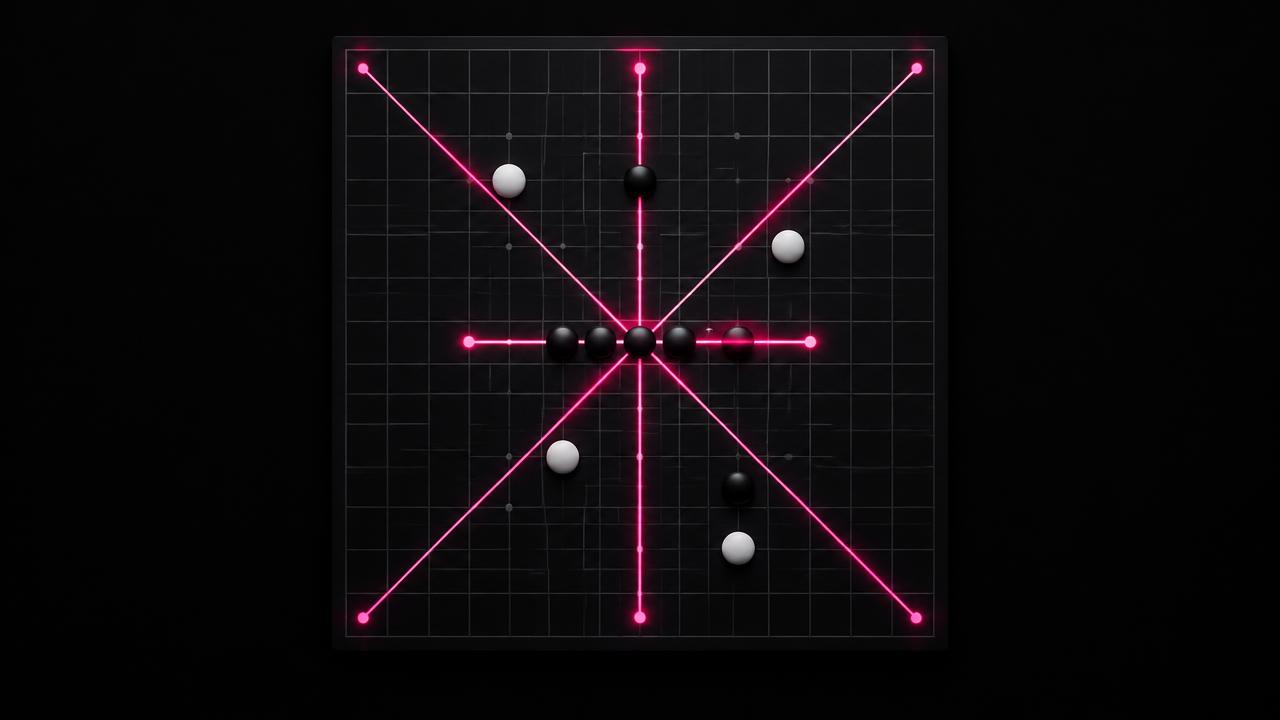
Continue the demonstration with White at i9 and Black at j8. Black has three consecutive stones at h8, i8 and j8. If g8 and k8 are empty, this is a promising attacking shape. White should now look at the possible extensions before making another unrelated move. Black could use k8 to create four consecutive stones with both outer ends available.
For teaching purposes, suppose White instead plays j9. This is deliberately a mistake, not a recommendation for White. Black can place k8, producing h8 through k8. With g8 and l8 still empty, Black has an open four. White can occupy one endpoint, but Black can finish at the other. The important lesson is that a threat can become impossible to stop before the fifth stone appears.
Finish the example correctly
If White blocks g8, Black plays l8. The stones h8, i8, j8, k8 and l8 form an uninterrupted horizontal five. The game ends immediately. White does not get another turn to finish the row at h9, i9 and j9. If White chooses l8 instead, Black wins at g8 with the line g8 through k8.
Reset the board and change White's earlier move. After Black's third consecutive stone at j8, let White play k8 instead of j9. The right-hand extension is blocked, and Black no longer has the same straightforward open-four continuation. Black may still have other ideas, but the demonstration win is gone. This comparison teaches more than repeating the winning line alone.
Step 1 of 5
Black has three across row 8. White can prevent the open-four extension now.
Columns a to o run left to right. Rows 1 to 15 run bottom to top. h8 is the center.
Scan every direction on each turn
Before placing a stone, look for your own immediate five. Then look for the opponent's immediate five and whether you can stop it. After those urgent checks, examine open threes and useful connections. This order matters. If you can win now, you normally do not need to block a threat that would matter only on the opponent's next turn.
Through each recent stone, trace the horizontal line, the vertical line and both diagonals. Count consecutive stones, not nearby stones scattered across several lines. A diagonal can be easy to miss because it does not follow the board's drawn lines. Take a moment to name its two endpoints. This makes a possible completion much easier to see.
Know what is not a win
Five stones in a bent shape do not win. Five stones separated by a gap do not win until that gap is filled and the completed line meets the rules. A line containing an opponent's stone is interrupted. You also cannot use one Black stone as part of White's five, even if the arrangement looks like a continuous row from a distance.
In standard Gomoku, exactly five matters, so an overline of six is not a winning line. Renju adds restrictions for Black. Those differences are worth learning later, but do not mix them into your first freestyle exercise. State the rules clearly and use the same rules for the whole practice game.
Play a first game with a manageable goal
A useful first-game goal is to notice every four, not to win immediately. If you miss a threat, pause after the result and identify the turn when it became dangerous. You can use a local game to move both colors during study, then try the computer once you understand how the lines develop.
Avoid scattering stones around the board because the empty space looks inviting. New stones are usually easier to understand when they connect to existing activity. Ask what your move changes: does it extend a line, block an extension, join two plans or create a future threat? A move with a clear purpose is easier to review than one chosen at random.
Repeat the lesson with a diagonal
After the horizontal exercise, give Black h8, i9 and j10 with both ends available. The corresponding extensions are g7 and k11. These coordinates follow a diagonal because both the column and row change together. Add k11 and locate the two winning endpoints before playing White's block. You are practicing the same idea in a less familiar orientation.
When you can recognize the horizontal and diagonal versions without counting twice, start a normal game. Keep the simple turn routine: win if possible, stop an immediate loss, then improve your position. Gomoku becomes more interesting once the basic scan is reliable, because you can spend your attention on the choices that actually separate good moves from weak ones.
Frequently asked questions
Do Gomoku stones go inside the squares?
On a lined board, put stones where the lines cross. A digital board may draw clickable points or squares, but each location represents one board position.
Can I move a stone after placing it?
No. A normal Gomoku turn adds one stone to an empty point. Stones already placed stay there for the rest of the game.
Does the first move have to be in the center?
Center placement is a useful beginner choice. Some competitive opening rules require it, but ordinary freestyle does not require every opening to start there.
Put it into practice
Try these ideas against the computer or a friend.
Editorial standards and sources
Rules depend on the variant being played. Worked examples are study positions, and computer suggestions are not proofs of perfect play. Consult the linked rule sources when checking a disputed position.
Topics
Share this article
Read about the editorial byline, source selection and how to report a correction. Cover artwork is illustrative, not a record of the example position.