Key takeaway
Renju restricts Black, not White, in specific ways. Check the official definitions and legal continuations before calling a visual fork a forbidden move.
In this article
- Begin with the winning objective
- An overline has six or more stones
- A four is about a possible five completion
- A double four is a multiple-four restriction
- A real three needs the right continuation
- Double-three assessment has qualifications
- Exact five and other shapes need careful reading
- Keep opening rules separate from move restrictions
- Practice legality before tactics
Renju belongs to the five-in-a-row family, but it changes what Black is allowed to do. In ordinary freestyle Gomoku, a powerful fork or an overline can be a legal winning resource. Renju restricts Black's overlines, double fours and qualifying double threes. White is not subject to those same restrictions, so the color of the stone matters when evaluating a move.
The difficult part is not memorizing three prohibited labels. It is applying the definitions to the actual position. A group that looks like an open three may not be a real three for Renju purposes. Its continuation can be blocked, create an overline or depend on another forbidden move. Learn the visual warning signs, then verify the legal continuation.
Begin with the winning objective
Black's ordinary Renju line objective is exactly five consecutive stones. White can win with five or more. A horizontal, vertical or diagonal line can qualify. Stones do not move or get captured in normal Renju play. These familiar basics let you recognize the game, while the restrictions change which Black attacks are usable.
For Black, count the entire continuous run created by a candidate move. Do not stop counting at the five stones you hoped to make if the new stone also joins an existing neighbor into six. For White, an overline is not subject to Black's prohibition. The same geometric move can therefore have a different legal result depending on color.
An overline has six or more stones
Imagine Black at d8, e8, f8, h8 and i8, with g8 empty. Playing g8 joins six consecutive stones from d8 through i8. That is an overline. It is a freestyle win, but it is forbidden for Black in Renju. A player switching variants needs to check this possibility before filling a tempting internal gap.
A White stone in the same arrangement is evaluated differently because White does not share Black's overline restriction. This asymmetry is intentional. Do not assume a move is legal for Black merely because White played a similar one earlier. Also check each direction through a candidate, since an unexpected neighboring stone can lengthen a different line.
A four is about a possible five completion
Renju's formal definitions matter for identifying fours and double fours. A four is a relevant four-stone line configuration that can be completed to five with a move. It need not look like four consecutive stones. A broken four with one internal gap can be an immediate threat too. Merely counting visible continuous runs is not enough.
For example, Black at e8, f8, h8 and i8 has a completion at g8, assuming the complete move meets the rules. When evaluating a candidate that creates multiple fours, examine every qualifying configuration through the played point. Do not equate two endpoints of one straight four with two separate fours solely because both endpoints are winning choices.
A double four is a multiple-four restriction
Black may not create the prohibited multiple-four configuration with one move. The official rules define the shapes and their relationship to the played intersection. A useful beginner warning is a candidate that appears to make independent four threats in two directions. That warning should lead to a precise check, not replace the formal definition.
Set up two Black lines approaching the same empty junction and ask what each becomes after a stone there. Name the five completions, check whether the resulting configurations qualify as fours and inspect any longer run. If you cannot identify the actual completions, you have not finished the legality analysis. A shape's appearance alone does not tell the whole story.
A real three needs the right continuation
For Renju, a three is defined through its ability to become a straight four under the rule's conditions, not simply by three visible stones and adjacent empty points. The potential extension must be examined carefully. If it would be forbidden or would not create the required straight four, the initial shape may not qualify as the three you thought you saw.
This is why advanced tutorials spend time on false or apparent threes. A diagonal can look open but have a blocked outer endpoint. Another line may only extend through an illegal Black move. Counting both as real threes can lead you to reject a legal placement. Counting neither without checking can lead you to permit a forbidden fork.
Double-three assessment has qualifications
A move that appears to create two threes is a signal to examine the position more deeply. The official rules include qualifications and exceptions in the double-three assessment. You need to test whether the supposed threes can develop in the required legal way. A simple visual rule such as two open-looking threes means forbidden is too crude.
Work through one continuation at a time. Identify the candidate extension, the resulting straight four and the legal status of that extension. If its legality depends on another multiple-threat question, that question also needs evaluation. For serious study, refer to the official rules and worked examples rather than expecting a short beginner summary to cover every recursive case.
Exact five and other shapes need careful reading
A candidate can affect several lines simultaneously. The rules' treatment of a completed five, overlines and other forbidden shapes needs to be read as a whole, including any stated precedence and exceptions. Do not classify a complicated move only by the first three or four you notice. Inspect the full result in every direction.
For beginners, use uncomplicated examples first: a clear Black overline, a clear multiple-four fork and a clear double-three study position with legal extensions. Add exceptional cases later. This progression keeps you from learning an overbroad shortcut that is hard to undo. If a position is ambiguous, say which continuation you are uncertain about rather than claiming certainty from its appearance.
Keep opening rules separate from move restrictions
Official competitive Renju includes opening arrangements and procedures beyond the basic forbidden-move checks. The site's Renju option in computer and local play applies its Black-move restrictions, but that is not the same as implementing every tournament opening system. Selecting Renju should not be mistaken for choosing a particular official event format.
When studying an opening article, check which rules and procedure it assumes. A position proposed through a color-selection process can have a different practical context from a casual game that starts with normal alternating placement. You can learn useful patterns from both, but the setup and the permitted moves should be stated clearly.
Practice legality before tactics
Take a candidate Black move and first count every resulting uninterrupted line. Then identify the fours and possible real threes through the played point. Check the relevant continuations before deciding whether the move is allowed. Only after that should you calculate whether the move forces a win. Tactical strength cannot make an illegal move usable.
Repeat the same geometry with White to understand which restrictions disappear. Then return to ordinary freestyle and notice which Black attacks become legal again. These comparisons explain the purpose of the variant better than memorizing a forbidden list alone. Renju rewards the same careful observation as Gomoku, with an additional question before every ambitious Black attack: can this move and its promised continuations legally be played?
References
Frequently asked questions
Why does Renju have forbidden moves?
The restrictions reduce Black's first-move attacking advantage by limiting overlines and certain multiple threats. Tournament opening procedures address color selection separately.
Is every apparent double three forbidden?
No. Renju's assessment depends on whether the lines are real threes with the required legal continuations, including the rule's qualifications and exceptions.
Does the Renju option on Gomoku.now include tournament openings?
The site's option applies Black's forbidden-move checks in computer and local play. It should not be treated as a claim that every official tournament opening procedure is implemented.
Put it into practice
Try these ideas against the computer or a friend.
Editorial standards and sources
Rules depend on the variant being played. Worked examples are study positions, and computer suggestions are not proofs of perfect play. Consult the linked rule sources when checking a disputed position.
Topics
Share this article
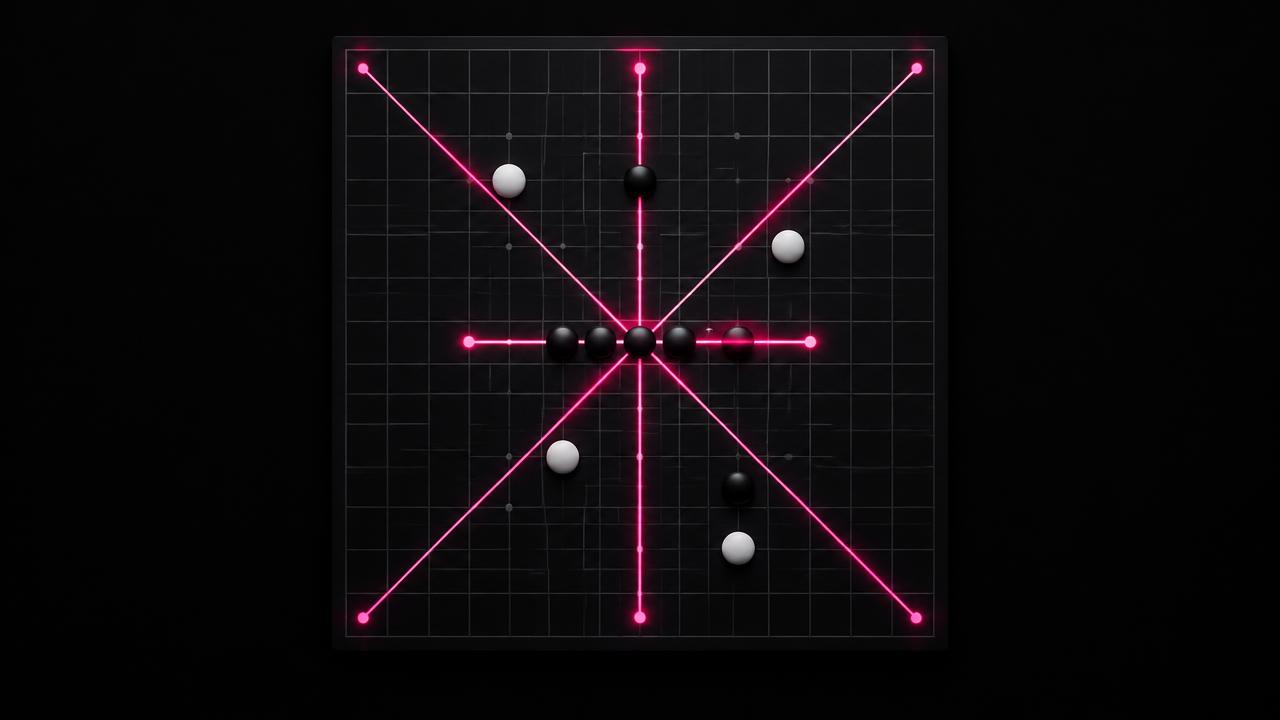
Read about the editorial byline, source selection and how to report a correction. Cover artwork is illustrative, not a record of the example position.